Choose a wireless tyre inflator UK buyers can actually use

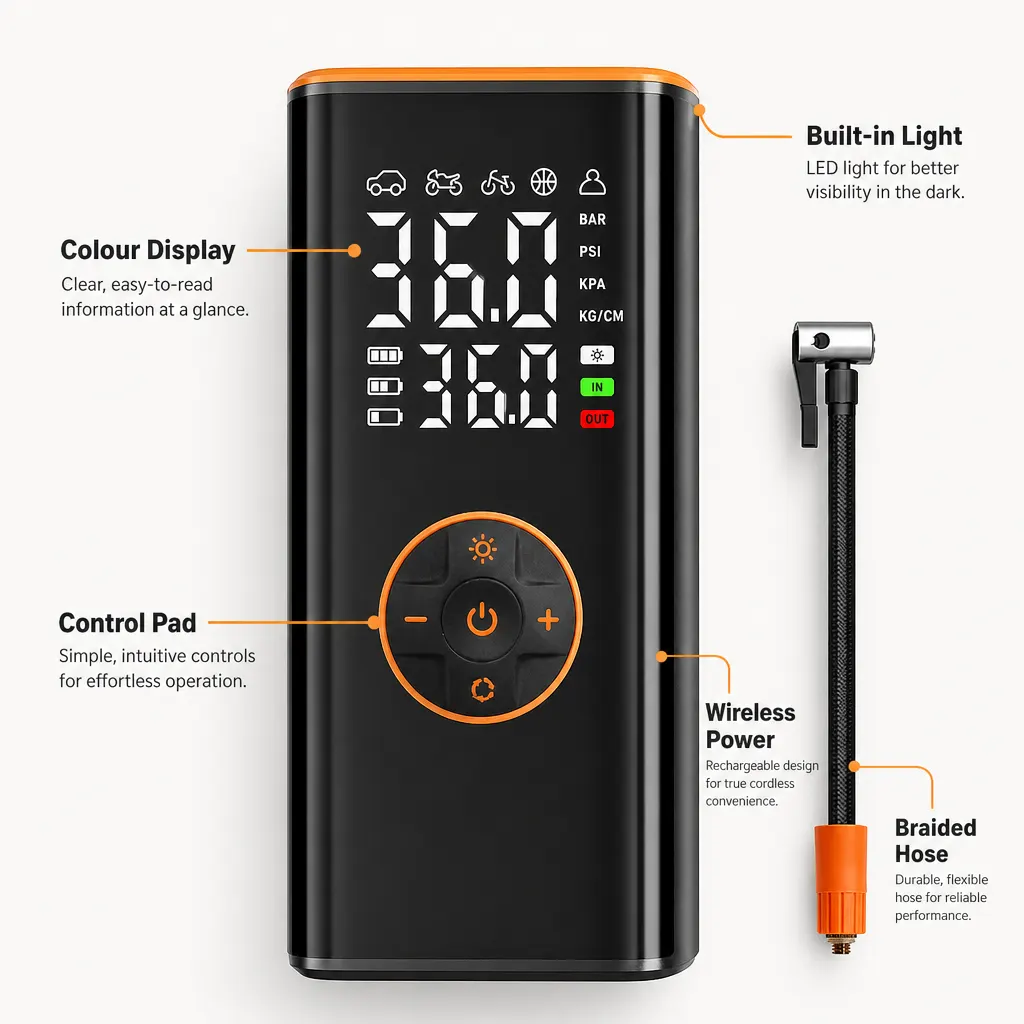
Wireless Car Tyre Inflator With Colour Display controls and screen

If you need to deal with low tyre pressure before a journey, a wireless tyre inflator UK buyer should first check the vehicle handbook for the correct pressure, inspect the tyre for obvious damage and confirm that the inflator is suitable for the valve and pressure required. The Wireless Car Tyre Inflator with Colour Display is documented as a wireless configuration with a digital pressure display and built-in lighting. Those facts make it relevant to a driver who wants to check and add air without depending on a fixed forecourt machine, but they do not by themselves confirm battery runtime, inflation speed, connector fit or suitability for every vehicle.

The decision is therefore less about choosing the longest list of features and more about matching a simple job to documented information. A time-poor driver may want something available in the boot before commuting, a motorway journey or a holiday trip, while another buyer may only need an inflator in a home garage. In both cases, separate the product facts from assumptions: a display is not proof of measurement accuracy, wireless operation is not proof of long battery life, and built-in lighting does not tell you how bright or how long it operates.

Start with the UK car journey or home garage setting

The setting matters because the same low-pressure warning can create very different practical problems. On a driveway before work, you may have time to read the handbook, connect the device and recheck the pressure. At a packing bench beside the car before loading for a holiday, you may want to confirm the tyres before adding weight and setting off. Outside a workshop or garage in fading light, the built-in lighting feature may be relevant because it is one of the documented characteristics of this configuration.

A wireless inflator can be appealing when the alternative is finding an open petrol-station air machine or arranging a separate garage visit. However, convenience should not change the basic decision. If a tyre is losing pressure repeatedly, visibly damaged or suspected of having a puncture, adding air is not the same as finding and resolving the cause. Treat the inflator as a pressure-checking or inflation aid only where the tyre and the situation appear appropriate, and seek professional inspection when the condition is uncertain.

Check the pressure job against documented facts

Before buying, write down the exact job: checking pressure, adding air to one tyre, preparing the car before a trip or keeping an emergency option in the boot. Then compare that job with what is actually documented. This product has a digital pressure display, so it is reasonable to look for a clear reading and understandable pressure units in the product information or instructions. The supplied facts do not state the display size, measurement range, unit options, accuracy, hose arrangement, charging method or battery capacity, so none of those details should be assumed.

The product is described as the colour-display configuration selected for the listing, with wireless operation and built-in lighting. That gives a buyer three points to investigate: whether the display can be read in the conditions where it will be used, whether the wireless setup suits the intended storage arrangement and whether the lighting helps with locating the valve or operating the device. It does not document the product's dimensions, weight, runtime or recharge time. Those missing details matter if the inflator must be stored in a small car or kept ready for an unplanned stop.

Use this purchase checklist at the car or workshop

Check 1: confirm the vehicle manufacturer's recommended pressure before touching the inflator. Do not choose a target by guessing from the appearance of the tyre or copying a number from another car. Check 2: inspect the product information for the connection needed by your vehicle and confirm that the stated pressure range covers the job. The frozen product facts do not list connector types or a pressure range, so those are questions to resolve rather than features to presume.

Check 3: assess the surface and setting. On a driveway, workshop forecourt or packing area, you need a stable place to work and enough access to the valve. Check 4: confirm what is included and how the unit is powered; the frozen listing does not provide a kit-content list or charging instructions. Check 5: consider the environment, including low light, rain and cold, without assuming weather resistance. Check 6: plan aftercare by following the instructions, storing the unit as directed and checking its readiness before relying on it.

Know the mismatches before putting one in the boot

This product may be a poor match if you need confirmed technical information that is not present in the listing. For example, a buyer who needs a specified battery runtime, a stated inflation rate, an exact maximum pressure, a known hose length or a confirmed connector set should not infer those details from the words wireless, digital or colour display. The available facts only establish the wireless colour-display configuration, digital pressure display and built-in lighting feature. Ask for the missing information or choose only after checking the full instructions.

It may also be the wrong purchase for a driver who expects an inflator to repair a puncture, diagnose a leak or replace professional help. A low-pressure warning can have more than one cause, and the product description does not claim repair capability, diagnostic functions or suitability for damaged tyres. Buyers should be especially cautious before a long journey, after contact with a kerb or when pressure falls again soon after inflation. In those situations, checking the tyre and obtaining appropriate assistance is more important than simply carrying an extra device.

Compare a portable option with a forecourt air machine

A forecourt air machine may suit someone who lives close to a petrol station and rarely needs to check pressure away from home. Its main attraction is that it is already installed at the place where the driver stops, so there is no separate device to store or prepare. The trade-off is dependence on opening hours, location and availability. A wireless inflator is considered for a different reason: it can be kept with the car or at home and used where the pressure issue is discovered, subject to its documented power, connection and operating instructions.

The comparison should stay practical rather than promotional. Ask where the problem normally appears: on the home drive, beside a warehouse, outside a studio or at a roadside stop. Ask whether built-in lighting would be useful in that setting, and whether a digital pressure display is easier for you to interpret than a basic gauge. Then check the missing details before deciding, especially charging and storage guidance. If you prefer a garage to handle tyre pressure or need a confirmed specification for frequent work, a product with fuller published information may be a better fit.

Prepare a simple pre-journey pressure routine

Park on a suitable, stable surface and use the vehicle handbook or the vehicle's stated information to identify the recommended pressure. Look over each tyre before inflating, paying attention to anything visibly unusual rather than treating the warning light as the whole diagnosis. Connect the inflator according to its instructions, read the digital pressure display and use the stated target rather than an estimate. If the connection does not fit securely, the reading is unclear or the tyre appears damaged, stop and resolve that issue instead of forcing the process.

After adding air, check the reading again and make a note of any tyre that behaves differently from the others. Keep the device's lighting feature in mind if the valve is difficult to see in low light, but do not assume that the light replaces a safe working position or inspection. Before storing the inflator, follow the supplied aftercare and charging directions. The product facts do not provide a recharge interval or runtime, so the safest practical habit is to check its readiness before a planned journey rather than discovering its condition during an urgent one.

Take the next step with the missing questions answered

Before selecting the Wireless Car Tyre Inflator with Colour Display, make a short list based on your own car and storage point. Confirm the valve connection, required pressure range, power and charging method, dimensions, contents, operating instructions and any stated environmental limitations. Also decide whether the digital pressure display and built-in lighting address a real problem at your driveway, packing area or garage. These are not minor details: they determine whether the product can complete the job you have in mind rather than merely resembling a suitable purchase.

If the documented information matches your needs, keep the vehicle manufacturer's pressure guidance with the car and treat the inflator as one part of a sensible tyre-check routine. If key answers remain unavailable, do not fill the gaps with assumptions about speed, accuracy, battery life or compatibility. Compare the listing with the product instructions or ask for clarification before buying. That approach gives a UK driver a clearer decision: choose the wireless configuration for its confirmed display and lighting features only when the unresolved practical checks have also been satisfied.